
For ecommerce SEO in Singapore, which kind of page best serves a shopper's query? A category page, product page and buying guide may all be contenders. Choosing between them is central to keyword targeting, and the wrong assignment can miss the shopper's task.
The old advice — one keyword, one page — sounds tidy. But Google can show different page types for the same query. Shoppers may want to browse a range, compare models or buy a known item.
A single product page may not satisfy someone browsing a broad range. A thin category listing may not provide the help a comparison shopper wants. The practical checks below untangle these assignments without guessing.
In this blog, we explain how to match a Singapore search term to a suitable page. We cover:
- The searcher's task and live results
- Catalogue and Search Console checks
- When overlapping visibility warrants investigation
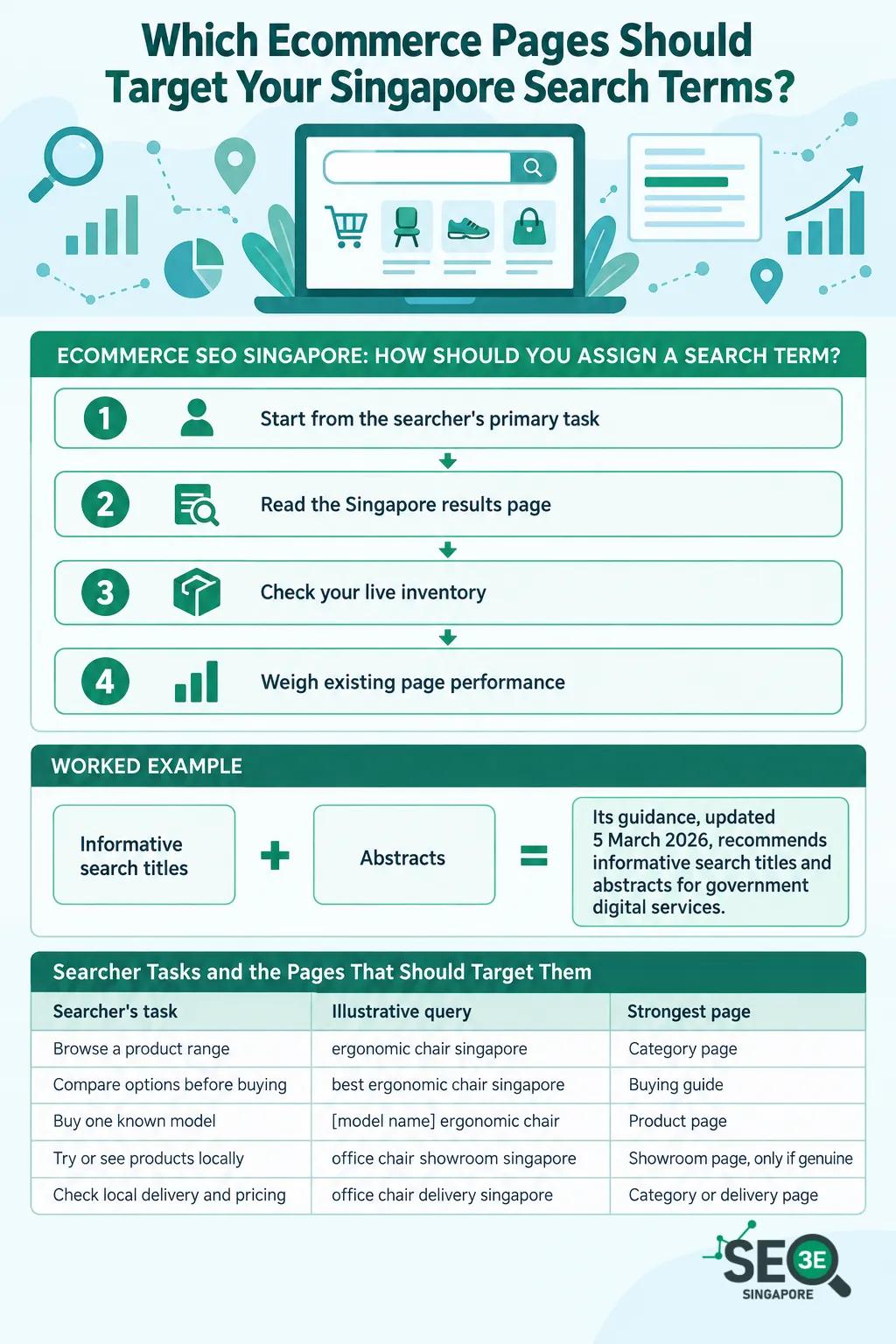
ecommerce SEO Singapore: How Should You Assign a Search Term?
For ecommerce SEO in Singapore, start by matching the term to the shopper’s task, then check live search results, available inventory and existing page performance. This is a working method rather than a fixed rule, so test it against the page that can best finish the task. Google’s people-first content guidance offers general context but does not choose a page type for a particular query. For broader search engine optimisation across page types, see our SEO services page.
1. Start from the searcher's primary task
Read the query for its stage. Broad commercial words can suggest browsing, comparison modifiers can suggest research, and a named model can suggest purchase. As a starting point, choose a strongest destination for the primary task without assuming that other useful pages cannot also appear.
2. Read the Singapore results page
Existing results offer clues about what Google considers relevant. Classify the standard web listings by each destination's main function:
- Several purchasable products suggest a category.
- One purchasable model suggests a product page.
- Advice-first content suggests a guide.
A commercial-sounding title alone does not settle the classification.
3. Check your live inventory
A category may suit a broad term if its products fit the query, are available, and offer a meaningful choice. Relevance comes before ambition.
4. Weigh existing page performance
Search Console can show which pages receive impressions and clicks for a term. An impression is a recorded appearance in search results; clicks are visits from those results. Average position is the average reported position of the topmost result for the page or grouping being examined, not a fixed rank. A suitable page already doing useful work may be worth improving rather than replacing, after checking the page's query and position data.
When Should a Category Page Take the Query?
A category page is the strongest destination for a broad shopping query when shoppers want a useful selection. Google Search Central says a page should clearly serve its purpose; for a category page, that means the selection must match the shopper's task. Before committing, check that the listing delivers what it promises; a technical SEO audit can help.
The framework favours improving an existing category that already serves the task. Consider a new category for a distinct range with enough relevant, available stock. We would not create a page just to put 'Singapore' in its title. Nor would we push a useful category out of search because stock is temporarily thin. Check replenishment plans and whether the remaining assortment helps shoppers. These checks still need to be run on the store's actual catalogue, stock forecast and technical setup.
1. Product relevance
Every product on the listing must match what the searcher asked for. A category padded with near-identical variants or loosely related items weakens its own claim to the term.
2. Stock continuity
For ecommerce SEO Singapore planning, check stock continuity before assigning a broad query to a category. Ask whether bestsellers stay in stock and how quickly refills arrive. Consider whether an out-of-stock week is a blip or a pattern. Depth of choice matters more than one bad week.
3. Delivery and local promises
Check whether the page gives shoppers accurate delivery coverage, timelines, SGD pricing and warranty information where relevant to their choice.
4. Filtering and usability
Expose the filters shoppers actually use — price, material, size, features — so the page supports selection instead of showing one long grid. The government's own Digital Service Standards are a useful benchmark here: the government asks its multi-page websites to provide a site search function and to write labels in clear, simple words.
5. Indexability
Keep important category, pagination and product links crawlable, and check the index status of pages intended for search. Not every filter combination needs to be crawlable or indexed: Google's faceted-navigation guidance describes preventing unnecessary crawling, including with robots.txt. Blocking crawling alone does not guarantee removal from the index; a noindex directive must be accessible to Google to be read.
Searcher Tasks and the Pages That Should Target Them
| Searcher's task | Illustrative query | Strongest page | Why that page wins |
|---|---|---|---|
| Browse a product range | ergonomic chair singapore | Category page | A selection of purchasable options finishes the task |
| Compare options before buying | best ergonomic chair singapore | Buying guide | Criteria, comparisons and recommendations come first |
| Buy one known model | [model name] ergonomic chair | Product page | One product answers the whole query |
| Try or see products locally | office chair showroom singapore | Showroom page, only if genuine | The task shifts from browsing to visiting |
| Check local delivery and pricing | office chair delivery singapore | Category or delivery page | Singapore-specific promises decide usefulness |
When Do a Product Page or a Buying Guide Serve Better?
A product page is usually the right destination for an exact-model search, while a buying guide often serves a comparison task such as 'best ergonomic chair Singapore'. The choice depends on the searcher's task and the results, so confirm it against a live search before acting.
According to Google Search Central's guidance on creating helpful, reliable, people-first content, a buying guide should answer the reader's comparison question before sending them to a result. Answer that question first, then provide useful routes to relevant shopping pages.
What Should You Check in Singapore Search Results Before Deciding?
Start by classifying Singapore results by the destination page's main function, and inspect shopping units, People Also Ask boxes and local packs separately. A dated capture is one sample at one moment, not a definitive picture of every Singapore result. Confirm the method against a fresh search before acting.
1. Classify the organic listings by destination function
Work through the standard web listings and label each by what the page mainly does. Note shopping units, advertisements, People Also Ask boxes and any local pack separately from standard web listings; shopping units can include both paid and organic product listings.
2. Inspect local packs and People Also Ask
A local pack on a showroom-style or area-modified query may suggest a visit-oriented task. People Also Ask questions about fit, trials and local availability can suggest supporting content; they need not overrule the dominant task.
3. Repeat the check by device and location
Check relevant Singapore locations and devices, recording the query, language, device, location method and any personalisation limitations. Repeat the capture rather than treating one desktop view as definitive.
4. Know your flip triggers
Comparison-led results and thin category stock could favour a guide; results focused on a known model's purchase pages could favour its product page. For a visit-oriented query, a showroom page may fit if the business genuinely has a customer-facing showroom; an online-only store should not imply one. Check the showroom and business-profile details, then confirm these triggers against a fresh Singapore search before acting.
An Illustrative Keyword-Targeting Worksheet
| Illustrative query | What the results favour | Recommended target | What would flip the decision |
|---|---|---|---|
| ergonomic chair singapore | Category listings dominate | Improve the existing category | Comparison-style listings dominate while category stock runs thin |
| best ergonomic chair singapore | Guides and comparisons | Improve the guide and its links into shopping | Transactional listings take over the first page |
| [model name] ergonomic chair | That model's purchase pages | Keep the product page as the target | Results shift towards research-style comparisons |
| office chair showroom singapore | Local pack and store pages | Showroom page, only if a showroom exists | An online-only store should not imply a physical location |
Is Overlapping Visibility Always Keyword Cannibalisation?
Not necessarily. Shared query visibility alone does not establish harm or mean that useful pages should be merged. A category and a guide may serve different tasks, even when both receive visibility for a broad term. The data can only tell you which pages earn impressions and clicks, not whether they appeared together in one result.
Before drawing conclusions from an export, record the period, country, device, search type, query selection and exclusions. Google's Search Analytics API caps a response at 25,000 rows per request, so larger exports are split across requests. Check filters, row limits and completeness: Search Console omits some anonymised queries, and detailed data can be truncated. Treat the export as a useful clue, not a verdict.
Before calling it cannibalisation, run these four checks:
- In Search Console's Performance report, select the period, Singapore, search type and device. Filter the query, then open Pages to identify reported landing pages.
- For a weekly query-by-page breakdown, use the Search Analytics API with date, query and page dimensions and the same filters. Export the daily rows, group them by week, query and page, and sum clicks and impressions. Calculate weekly average position as the daily positions weighted by their impressions, not a simple average of daily averages. Alternatively, filter each query and page in the report and export its Dates view with weekly granularity.
- Record the extraction method and check for omitted anonymised queries, row limits, truncation and incomplete recent data. Page-row impressions are not distinct searches; page and property totals are aggregated differently. Neither report nor API exports guarantee every detailed row.
- Repeat the Singapore results capture. Aggregate data cannot prove simultaneous appearances; a capture shows only what appeared in that search at that moment. Use both sources together before changing pages.
Search Console Checks Before Calling It Cannibalisation
| Check | What it tells you | What it cannot tell you |
|---|---|---|
| Filter one query and list its landing pages | Which pages earn impressions and clicks for that term | Whether two pages appeared in the same individual search |
| Weekly query-by-page breakdown | Whether visibility persists or spikes once | Why movement happened in a given week |
| Extraction completeness review | Whether omitted anonymised queries or row limits skew the data | The true total of searches never recorded |
| A fresh, dated results capture | What Google rewards in Singapore today | How results differ on another device or location |
How Would the Decision Look on an Illustrative Worksheet?
Picture a wholly hypothetical Singapore office-chair store with a category, product pages and a buying guide. This is not a client engagement, a live results capture or a Search Console export. The queries and all conditions below are imagined; this worksheet is hypothetical and should be checked before use.
For 'ergonomic chair singapore', assume category listings predominate, the existing category has useful visibility and its available chairs offer meaningful variety. On those assumptions, consider improving that category. For a comparison term, assume guide-led results and useful guide visibility: consider improving the guide and its links to shopping pages. For an exact-model query, assume the product is available and purchase pages for that model fit the results: consider retaining the product page as the target.
Record the evidence supporting each choice, your confidence, what would reverse it and when to review it. Comparison-heavy listings and thin stock might favour the guide instead; a different task or results composition might change the model-query decision. The aim is a repeatable worksheet rather than a magic formula.
If a real client-derived example is ever used, the proposed boundary is to withhold identifying and commercially sensitive details and obtain authorised client approval after internal review. The reviewers, publication policy and approval are not confirmed; this worksheet does not imply a client engagement.
How Do You Link the Pages and Review the Decision?
Link the guide, category and relevant products where the links help navigation, using descriptive anchors rather than forcing an identical phrase. Google's SEO starter guide provides useful guidance on anchor text, but the final choice should make sense for the reader. If you want a second opinion on the review, contact us for an ecommerce SEO review.
Then measure like an analyst, not a believer. Compare Search Console clicks and average position for the target pages before and after the change, while remembering that stock levels, promotions, demand shifts and competitor moves all contribute. A before-and-after comparison is an observation, not a proven cause, and late data can still be incomplete. Re-check after implementation, allowing more time if traffic is sparse or results are unstable. Analytics purchases attributed to organic sessions entering a page are not conversions attributable to an individual Search Console query.
Link the three page types together like this:
- From the buying guide, link the relevant recommendation sections to the category and to the specific products they discuss.
- From the category, add a short selection guide plus clear delivery and warranty information — support the choice without turning the listing into a long article.
- From product pages, keep category breadcrumbs and add a genuinely useful buying-guide link.
- Use descriptive anchor text that varies naturally, instead of forcing the identical exact-match phrase into every link.
- Consider keeping the guide and category separate when they serve different purposes, and let the canonical decision follow the page's primary task.
Conclusion
Match each search term to the page that can finish the searcher's task:
- A category for browsing
- A product page for a known model
- A guide for comparison
- A local or showroom page only where a real one exists
Confirm the proposed choice against live Singapore results, stock and Search Console data. Treat overlapping rankings as a signal to investigate, not a verdict. These page choices are conditional, so confirm each one against live results and data.
Support the choice with helpful links between guides, categories and products. Re-check before calling any result durable. Good ecommerce SEO in Singapore depends on making this decision carefully.
We help Singapore online stores with this work. Our services include keyword and competitor research, category and buying-guide content, technical SEO audits and local SEO. If you are unsure which page should own a term, get in touch and we will take a look with you.
Not Sure Which Page Should Own the Term?
Tell us your top ecommerce queries and we will review which pages should target them, and why.
Frequently Asked Questions
A category may be suitable when the query calls for a useful selection. Check Singapore results and available stock before deciding. This is a conditional judgment, not a verified result for every broad query.
No. Overlap alone does not prove harm. Review each page's task, Search Console query-page data and fresh results captures before considering consolidation. These checks inform the decision but do not automatically prove that one page holds another back.
A guide may fit when the term suggests comparison and the Singapore results support that task. Focus on useful criteria and recommendations, with links to relevant shopping pages. This is a conditional judgement to confirm against live results before publishing.
Not directly. Its reports aggregate by page and omit some anonymised queries, so a query-page row shows which pages earned impressions and clicks, not simultaneous appearances. A dated results-page capture can show whether both appeared in that particular search, not whether they always appear together.
No. The proposed approach is to improve a suitable existing page when it serves the task, and consider a new page for a distinct unmet task with no suitable destination. A new category also needs a relevant, available selection. This is a decision framework, not a universal rule; confirm it with a practitioner.
3E SEO Services
Author
Singapore SEO specialists in ranking keywords for WordPress sites in Google search results. From SEO-friendly hosting to Google PageSpeed scores, every part plays a role in your SEO journey. As an IT and SEO company in Singapore, we focus on ranking our clients' websites, and our own, to set an example for our customers.